
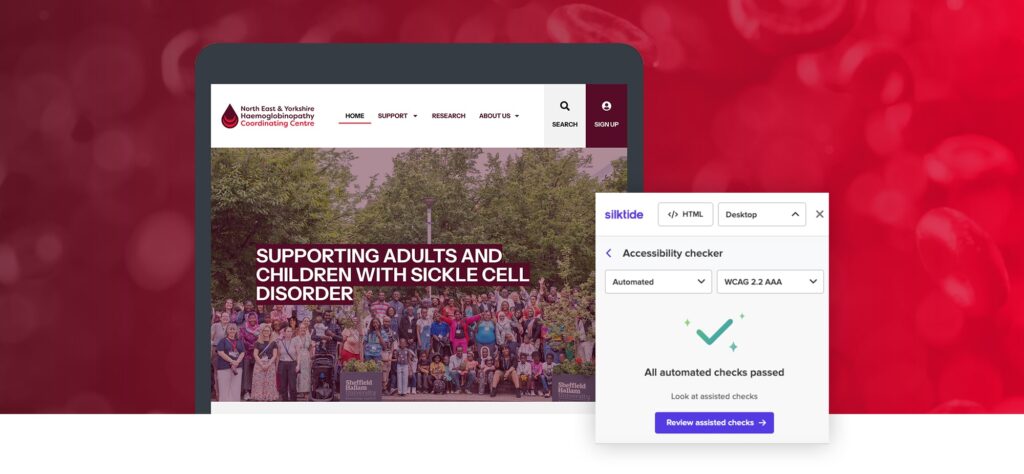
Haemoglobinopathy Coordination Centre Website Achieves WCAG-2.2 AAA
In today’s digital-first world, a website is an organisations front door. For a growing number of people, that door remains locked. One billion people worldwide have a disability, yet many websites are built with barriers that prevent them from accessing information, purchasing products, or engaging with services. For leading organisations, web accessibility is no longer just a “nice-to-have” or a box to tick; it’s a strategic imperative. This means moving beyond basic compliance and aspiring to the highest standards, such as WCAG 2.2 AAA.
Why Leading Organisations Must Aim for WCAG 2.2 AAA
When the North East and Yorkshire region Haemoglobinopathy Coordination Centre sent out the brief for their new website, it needed to set the standard. As a hub for expert care and support, they specialise in sickle cell disorder providing comprehensive services for patients and healthcare professionals. For many internet users, particularly those with disabilities, accessibility isn’t a “nice to have”; it’s a fundamental requirement. That’s why organisations that lead in their industries, communities, and sectors must also lead in digital accessibility.
What is WCAG 2.2 AAA?
The Web Content Accessibility Guidelines (WCAG) are a set of international standards developed by the World Wide Web Consortium (W3C). WCAG has three levels of conformance: A (the lowest), AA, and AAA (the highest). Each level builds on the previous one.
- Level A addresses basic accessibility issues and removes the most significant barriers.
- Level AA is the most common target for web accessibility laws globally. It addresses a wider range of issues and provides a much better user experience for people with disabilities.
- Level AAA goes above and beyond, ensuring an exceptionally inclusive experience. It includes stringent requirements that address barriers for users with a wide range of visual, auditory, cognitive, and motor disabilities.
Why Aim for AAA?
While most legal requirements mandate WCAG AA, striving for AAA is a marker of true digital leadership. Organisations that need to achieve this level of accessibility are those with a moral and legal obligation to be as inclusive as possible. This includes:
- Government bodies and public sector organisations: Websites for government services, healthcare, and education must be fully accessible to all citizens.
- Major financial institutions: Banking, investment, and insurance websites must be usable by people with disabilities to ensure equal access to essential financial services.
- E-commerce giants and large corporations: To capture the spending power of a significant portion of the population and avoid legal and reputational risks, these companies are motivated to make their websites accessible to everyone.
- Companies that serve a high percentage of users with disabilities: Organisations that provide services or information directly to people with disabilities, such as disability-related non-profits or assistive technology developers, should aim for AAA to best serve their core audience.
A website built to AAA standards is not only more accessible, it is also better for everyone. Clearer design, logical navigation, and robust code lead to a more intuitive and efficient user experience for all users, regardless of ability.
How is Accessibility Measured?
Achieving a high WCAG score is a combination of automated testing and manual human evaluation. Automated tools can quickly scan a website for common issues, such as low colour contrast, missing alt text for images, or improperly structured headings. However, these tools can only catch a fraction of the problems.
True conformance requires a comprehensive manual audit by human accessibility experts. They perform detailed checks, including:
- Keyboard-only navigation: Can a user navigate the entire site without a mouse?
- Screen reader testing: Does the site’s content make sense when read aloud by assistive technology?
- Logical flow and context: Do page elements, such as headings and form fields, provide clear context and follow a logical order?
- Video and audio transcripts: Are captions and transcripts accurate and easy to access?
This dual approach ensures that both the technical code and the user experience meet the strict standards of WCAG.
Consequences of Inaction
Failing to achieve an appropriate accessibility score can have serious consequences.
- Legal and Financial Risks: In many countries, accessibility is a legal requirement. Failure to comply can lead to lawsuits and substantial fines.
- Reputational Damage: An inaccessible website sends a clear message that a brand is not inclusive. This can lead to public backlash, boycotts and a loss of customer trust and loyalty.
- Lost Revenue and Market Share: The disability community and their family and friends represent a huge market. An inaccessible website can exclude this entire demographic, resulting in lost sales and missed opportunities.
- Negative SEO Impact: Many accessibility best practices, such as providing descriptive alt text and proper heading structure, also improve a website’s search engine optimization (SEO), leading to better search rankings. An inaccessible site can therefore miss out on valuable organic traffic.
Ultimately, web accessibility is not a burden; it is a fundamental aspect of modern web development and a strategic investment in a company’s future. By becoming a leader in digital accessibility and embracing the highest standards, organisations can build a more inclusive brand, expand their market, and create a better experience for all users.